01 · White villages~1 hr drive
Ronda & the Pueblos Blancos
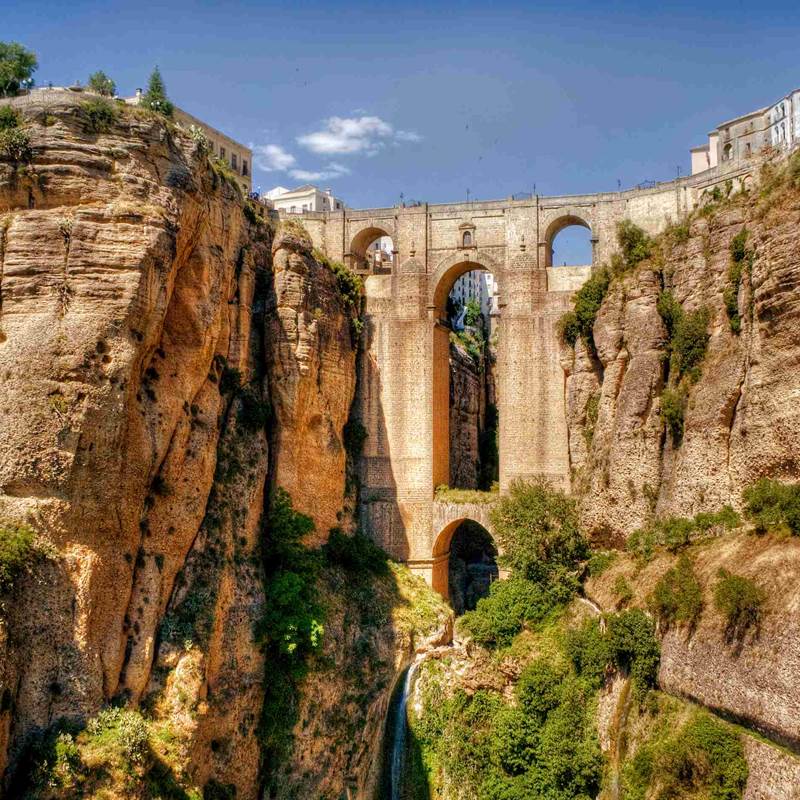
Ronda sits dramatically astride a 100-metre-deep gorge, split by the Tajo and crowned by the 18th-century Puente Nuevo. It is one of the oldest towns in Spain and the spiritual home of modern bullfighting, with the country's most beautiful plaza de toros at its heart. Wander cobbled lanes that have changed little since the Moors left, then peer over the railing at the Mirador de Ronda for one of the most photographed views in Andalucía. Lunch on rabo de toro (oxtail) in a tiled patio restaurant before exploring the Arab Baths down in the old town. From Ronda, the road threads through the Sierra de Grazalema to a string of whitewashed villages — Setenil de las Bodegas, with houses tucked under overhanging cliffs, and Zahara de la Sierra perched above a turquoise reservoir. Each pueblo blanco rewards a slow walk with hidden chapels, hand-painted ceramics, and viewpoints over endless olive country. The drive itself is half the experience: hairpin bends, cork oaks, and birds of prey circling overhead. Bring sturdy shoes — the cobbles are real. Plan a full day; you will not want to leave before sunset turns the limestone gold.
02 · Border crossing~35 min drive
The Rock of Gibraltar
Gibraltar is a slice of Britain bolted onto the southern tip of Iberia, and the contrast is unforgettable. Take the cable car to the top of the 426-metre limestone Rock for a view that takes in two continents, two seas, and three countries on a clear day. The Upper Rock Nature Reserve is home to Europe's only wild monkeys — the famous Barbary macaques — who will happily pose for photos but will also raid an open bag in seconds. Visit St Michael's Cave, a vast natural cathedral of stalactites used as a concert hall, then walk the WWII tunnels carved into the Rock by British engineers. Down in town, Main Street offers red telephone boxes, fish and chips, and tax-free shopping side by side with Spanish tapas. Bring a passport: there is a real border crossing, and the queue can be slow at peak times — going early or late helps. Walk across the airport runway (yes, really) to reach the town centre. Stop at Europa Point lighthouse for views across the Strait to the Rif Mountains of Morocco. Children love the dolphin-spotting boat trips that leave from the marina. End the day with a pint in a proper British pub — a surreal finish to a Spanish holiday.
03 · Strait of Gibraltar~1 hr 10 drive
Tarifa & whale-watching
Tarifa is the southernmost point of continental Europe and one of the wildest, most romantic spots on the coast. The town itself is a maze of Moorish lanes, surf shops, and Berber-style cafés, with the medina opening onto a long Atlantic beach. Where the Mediterranean meets the Atlantic, the waters are alive: pods of pilot whales live here year-round, and from spring through autumn you can see common dolphins, striped dolphins, sperm whales, orcas chasing tuna, and even fin whales — the second-largest animal on Earth. Responsible operators run small-boat tours of two to three hours, and sightings are almost guaranteed. The Strait is only 14 km wide here, so the Atlas Mountains of Morocco loom across the water like a mirage. Tarifa is also the kitesurfing capital of Europe, thanks to the Levante and Poniente winds — even watching from the beach is a spectacle. Walk out along the causeway to Isla de las Palomas, the actual southernmost tip. Lunch on grilled atún rojo (red tuna) at a chiringuito on Playa Los Lances. Time the trip for late afternoon and stay for the sunset over the ocean — there is nowhere else in Spain you can watch the sun fall into the Atlantic.
04 · Michelin & beach clubs~30 min drive
Marbella, Puerto Banús & Michelin dining
Marbella is the Costa del Sol's glamorous heart, and the eastern half of the trip — Puerto Banús — is its most outrageous showpiece. Cruise past super-yachts, Lamborghinis idling between palm trees, and shopfronts you usually only see on Bond Street. The old town of Marbella is a complete contrast: a perfectly preserved Andalusian casco antiguo of orange-blossom squares and whitewashed alleys. The region holds an astonishing concentration of Michelin stars: Skina (two stars) hides on a back street of the old town serving exquisite Andalusian tasting menus, Messina pairs creative Mediterranean cooking with a thoughtful wine list, and Nintai brings precise Japanese technique to local seafood. For something more relaxed, La Cabane on the beach at Los Monteros, or Trocadero Arena's sunken tables in the sand, are unforgettable. By day, beach clubs like Nikki Beach, Ocean Club and Trocadero set the tone with day-beds, DJs, and rosé. Visit the Avenida del Mar to see Salvador Dalí sculptures lining the seafront promenade. Combine an afternoon in the old town with sunset at the port for the full Marbella experience. Reservations are essential at the Michelin tables, often weeks ahead. Dress codes lean smart-casual; the locals do glamour effortlessly.
05 · Active outdoors~1 hr 20 drive
Hiking, cycling & the Caminito del Rey
Andalucía is a paradise for anyone who likes to be outside. The Caminito del Rey, north of Málaga, is a 7.7 km walkway pinned to the cliffs above the Gaitanes Gorge, 100 metres above the river — once known as the most dangerous footpath in the world, it was rebuilt in 2015 and is now safe but no less thrilling. Closer to home, the Sierra Bermeja above Estepona offers cork-oak trails to the summit of Los Reales (1,449 m) with views that stretch from Africa to the Sierra Nevada. Mountain bikers will find graded singletrack threading down from the hills towards the coast, while road cyclists tackle the legendary climbs of Puerto del León and Puerto de las Palomas. The coastal Senda Litoral, a continuous boardwalk being extended each year, lets you walk or cycle for hours along the sea. Birdwatchers should head to the Sierra de Grazalema and the marshes of the Guadiaro estuary, just minutes from the apartment. Trail running is superb in the cooler months, with the Salomon Casares trail race a favourite local event. Bring proper footwear, sun protection, and plenty of water — the southern sun is no joke even in spring. Local guides and bike-rental outfits can drop you at the trailhead and pick you up at the bottom.
06 · Fishing village charm~10 min drive
Estepona old town & marina
Estepona is the antidote to the Costa del Sol cliché — a real Andalusian fishing town that has been quietly transformed into the prettiest old quarter on the coast. Its narrow streets are lined with thousands of flowerpots, painted in pastel colours, and dotted with enormous public murals as part of the town's celebrated street-art route. Wander Plaza de las Flores in the early evening when locals gather for vermouth in the shade of orange trees. The seafront promenade stretches for over 20 km, perfect for a sunset walk past chiringuitos serving freshly grilled sardines on skewers — espetos — cooked over driftwood fires on the sand. The marina is small and unpretentious, with affordable seafood restaurants and weekend markets selling local olives, cheese, and ceramics. Visit the Orchid Garden, with three biospheres housing more than 1,300 species under huge glass domes. The Sunday flea market at the port is a long-standing local institution. Go in the morning for café con leche and a pan con tomate at a tiled bar, then climb to the Castillo de San Luis for views over the rooftops. Estepona is what Marbella was forty years ago — catch it before the secret gets out.
07 · Wine country~2 hr drive
Sherry, vineyards & Jerez
Few places on earth have a wine culture as singular as the sherry triangle — Jerez de la Frontera, El Puerto de Santa María, and Sanlúcar de Barrameda. A bodega tour is part history lesson, part theatre: cathedral-like cellars stacked with American-oak butts, the air thick and yeasty with flor, the wines poured straight from the cask by a venenciador with a long-handled silver cup. Try the full range — bone-dry fino and manzanilla, hazelnut amontillado, walnut oloroso, and the impossibly intense Pedro Ximénez — and you will never look at sherry the same way again. Pair them with chicharrones, langostinos de Sanlúcar, and tortillitas de camarones at a bar by the Guadalquivir. Jerez is also the home of the Royal Andalusian School of Equestrian Art, where Carthusian stallions perform a balletic show on Tuesdays and Thursdays. Don't miss flamenco in its birthplace at one of the city's peñas. Sanlúcar's August horse races on the beach are one of the most magical sporting events in Europe. Andalucía also produces excellent reds in the Ronda DO and crisp whites near Málaga, both within easier reach. Sign up for a tasting in advance; many bodegas are family-run and small. Hire a driver — these are wines that demand to be sipped seriously.
08 · Moorish heritage~2 hr drive
The Alhambra & Granada
The Alhambra is, quite simply, one of the most beautiful buildings in the world. The last great work of Moorish Spain, it crowns a wooded hill above Granada with red walls, slim towers, and a complex of palaces whose stuccoed walls, calligraphy, and water-filled patios still stop visitors in their tracks. The Nasrid Palaces — Court of the Lions, Court of the Myrtles, Hall of the Ambassadors — must be booked weeks, sometimes months, in advance, and entry is timed to the minute. The vast Generalife gardens drift down the hillside in a series of cypress walks, hidden fountains, and orange groves. Cross the river to the Albaicín, the medieval Moorish quarter, where every corner reveals another whitewashed terrace and tiled fountain — sunset from the Mirador de San Nicolás, with the Alhambra glowing against the snowy Sierra Nevada, is unforgettable. Granada is also one of the last cities in Spain where every drink at a bar comes with a free tapa, so bar-hopping in the centre is a proper meal. Hear flamenco in the cave-houses of Sacromonte, dug into the hillside by Roma families generations ago. The Cathedral and Royal Chapel hold the tombs of Ferdinand and Isabella, the monarchs who completed the Reconquista in 1492. Plan an overnight stay; the city deserves more than a day. Book everything early — it is one of the most-visited monuments in Europe for good reason.
09 · Beach days0–25 min drive
Hidden coves & coastal beach clubs
The stretch of coast between Sotogrande and Marbella hides some of the loveliest beaches in southern Spain, far from the package-tour crowds. Cala Sardina, just minutes from the apartment, is a quiet pebble-and-sand cove backed by pines, with a beach bar that has been run by the same family for decades. Playa de Bolonia, west of Tarifa, is a wild Atlantic curve of pale dunes — one rises 30 metres above the beach and is officially classed as a natural monument. The neighbouring Roman ruins of Baelo Claudia tumble straight onto the sand. For glamour, Trocadero Arena and Beach House Marbella offer day-beds in the sand, attentive service, and a proper kitchen. Sotogrande's Playa de Cala Sardina and Playa Alcaidesa are calmer, family-friendly options with good parking. Estepona's Playa del Cristo is a horseshoe bay with shallow water, perfect for small children. Try a chiringuito lunch — espetos de sardinas, paella mixta, and a cold rosé under a thatched canopy is the most Andalusian thing in the world. Pack reef shoes for the pebbly coves. Sun is fierce by midday year-round; an umbrella and good sunscreen are non-negotiable. Sunset at Bolonia, looking across the Strait to Africa, is one of those memories that stays with you forever.
10 · Culture & festivalsLocal & regional
Flamenco, ferias & living tradition
Andalucía is the cradle of flamenco, and seeing it performed live in its homeland is a different thing entirely from a tourist show abroad. Cádiz, Jerez, and Seville produce the great singers, dancers and guitarists, but smaller venues throughout the region — the peñas flamencas — offer evenings that often start late and end later, with the audience as much a part of the duende as the performers. The summer is feria season: every town and city dresses its young women in trajes de flamenca and its horses in ribbons, builds rows of striped casetas, and dances sevillanas till dawn. Estepona's feria in the first week of July, Málaga's in mid-August, and Jerez's horse fair in May are all worth planning a trip around. Holy Week (Semana Santa) brings hooded processions, brass bands, and incense-thick streets — Málaga and Sevilla do it most spectacularly. The Bienal de Flamenco in Sevilla every other autumn is the most important flamenco festival in the world. Smaller delights are everywhere: a Saturday-morning church service with Andalusian choir, an open-air guitar concert in a castle courtyard, an autumn olive harvest festival in a hill village. Ask locals what is on this week — there will always be something. Dress smart for an evening peña. Tip the dancers if a hat goes round; everyone does.